

Documentation Index
Fetch the complete documentation index at: https://docs.upsolve.ai/llms.txt
Use this file to discover all available pages before exploring further.
Overview
Tenancy management ensures each user only sees their relevant data through configurable filters. A tenant represents a group of users sharing the same data access permissions. Tenants can be registered via the Backend Setup endpoint or created manually through the interface.Filtering Types
Schema-Level Filtering
Isolates tenants to separate database schemas/databases. When enabled, all SQL queries for that tenant will be rewritten to reference tables from their designated schema/database instead of the default.- When to use: Complete data separation, compliance requirements, performance isolation
- Benefits: Maximum security, database-level isolation
- Example:
customer_schema_1,tenant_db_123
Only applies when configured: Schema-level filtering only affects tenants
who have a
schemaPreFilter value set. Tenants without this configuration
will query the default schema. This allows you to mix schema-based and
column-based tenancy within the same connection.Supported Data Sources
| Data Source | Supported | How It Works |
|---|---|---|
| MySQL | ✅ | The schemaPreFilter value replaces the database name in all queries. MySQL treats databases as schemas. |
| Clickhouse | ✅ | The schemaPreFilter value replaces the database name. Clickhouse uses databases as schemas (similar to MySQL). |
| Data Plane | ✅ | The schemaPreFilter value is appended to or replaces the schema portion of multi-part identifiers. |
| Postgres | ❌ | Use Column Pre-Filtering instead |
| BigQuery | ❌ | Use Column Pre-Filtering instead |
| Snowflake | ❌ | Use Column Pre-Filtering instead |
| MS SQL | ❌ | Use Column Pre-Filtering instead |
Setting Up Schema-Level Filtering
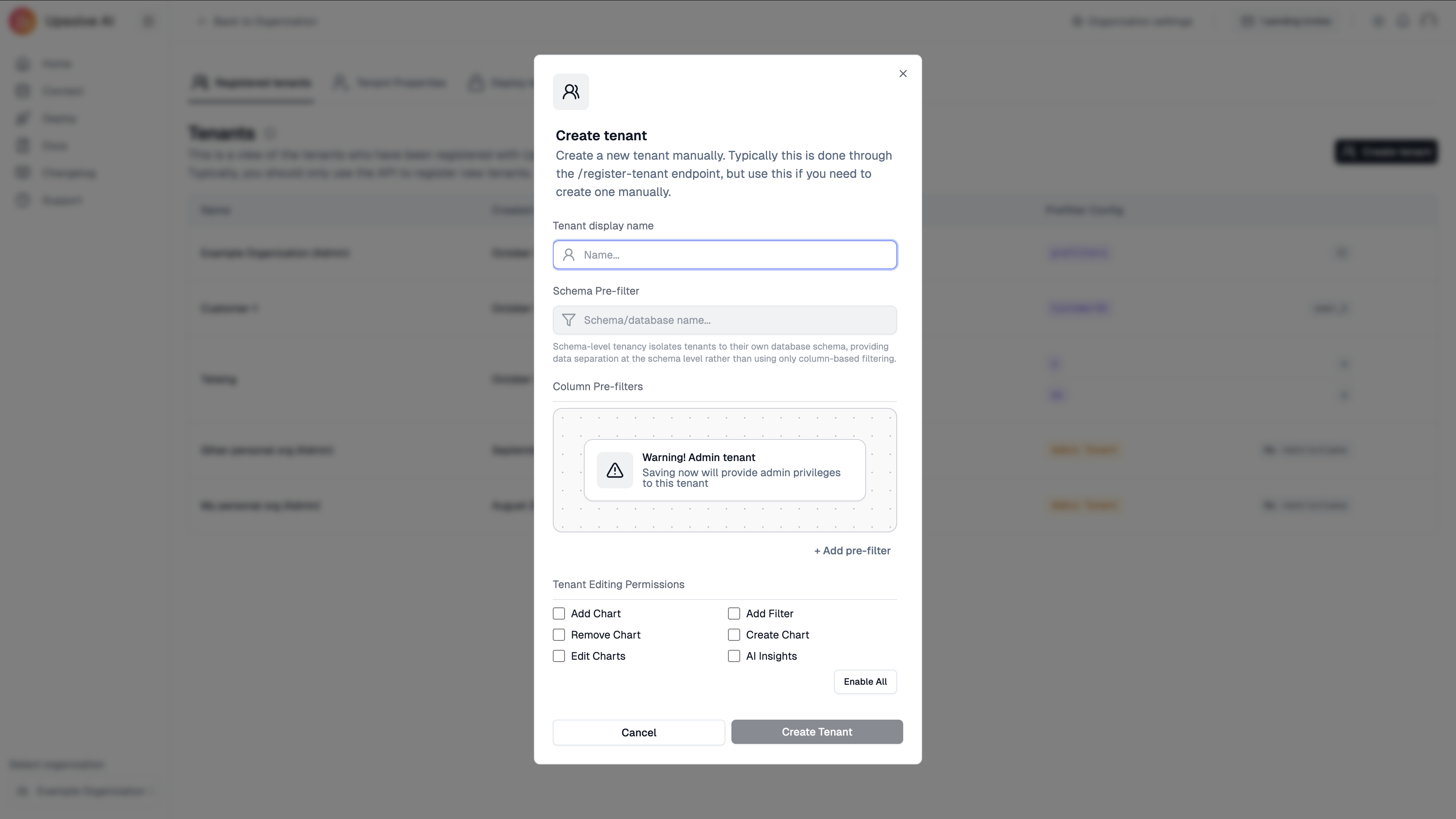
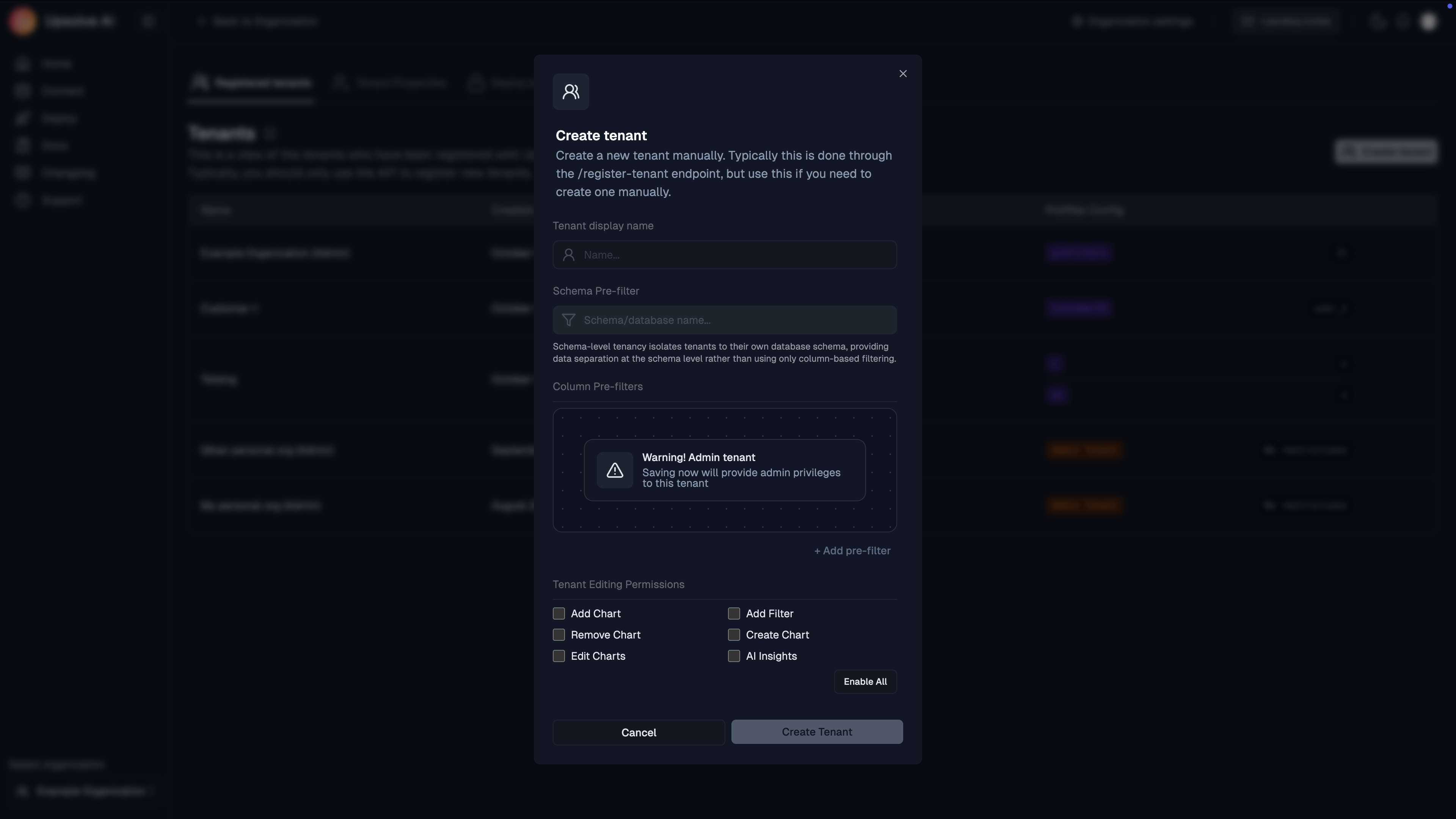
Via API (Backend Setup):- Navigate to Home → Deploy → Registered Tenants → Create tenant
- Enter the tenant display name
- In the Schema Pre-filter field, enter the database/schema name (e.g.,
customer_abc_database) - Save the tenant
How Query Rewriting Works
When a tenant withschemaPreFilter: "customer_db" runs a query, all table references are rewritten:
Connection Configuration for Schema-Based Tenancy
When using schema-based tenancy, you need to configure your connection with a Default Schema. This setting:-
Filters metadata: Only tables from the specified database/schema are included when computing metadata. This means your catalog will show tables as
A,B,Cinstead of(schema_one) A,(schema_one) B,(schema_two) A, etc. - Sets the default for admins: Admin users (those with empty prefilters) will query from this default database.
-
Falls back for tenants without schema: Tenants that don’t have a
schemaPreFilterconfigured will also use this default database.
Set Default Database/Schema
Configure the default database for schema-based tenancy: - MySQL: Enter
the database name in the Default Database (for Database Tenancy) field -
Clickhouse: Enter the database name in the Default Database (for
Database Tenancy) field - Data Plane: Enable schema-based tenancy and
select the Default Schema from the dropdown
Refresh Metadata
After setting the default database/schema, click Compute Metadata to
recompute the table catalog. The metadata will now only include tables from
your specified database.
Column Pre-Filtering
Filters data using column values within shared schemas.- When to use: Shared database with tenant identifiers, flexible multi-column filtering
- Benefits: Granular control, multiple filter combinations
- Example:
customer_id = 'user_123'ANDregion = 'us-east'
Creating Tenants
Navigate to Home → Deploy → Registered Tenants → Create tenantRequired Fields
Tenant Display Name- Human-readable identifier
- Example:
Customer ABC Corp
- Schema Pre-filter: Database/schema name for schema-level filtering
- Column Pre-filters: Column name + value pairs for row-level filtering
- Multiple filters supported (AND logic)
- Required if no schema pre-filter specified
Optional Configuration
You can register a tenant by following the Backend Setup instructions. Tenant Editing Permissions- Add/Remove/Create/Edit Charts
- Add Filters
- AI Insights
- Key-value pairs for additional tenant information
- Example:
billing_tier: premium,region: us-east
Validation Rules
- Tenant name required
- Either schema OR Column Pre-Filtering must be configured
- Empty filter names/keys not allowed
- Warning: No filtering = admin access to all data
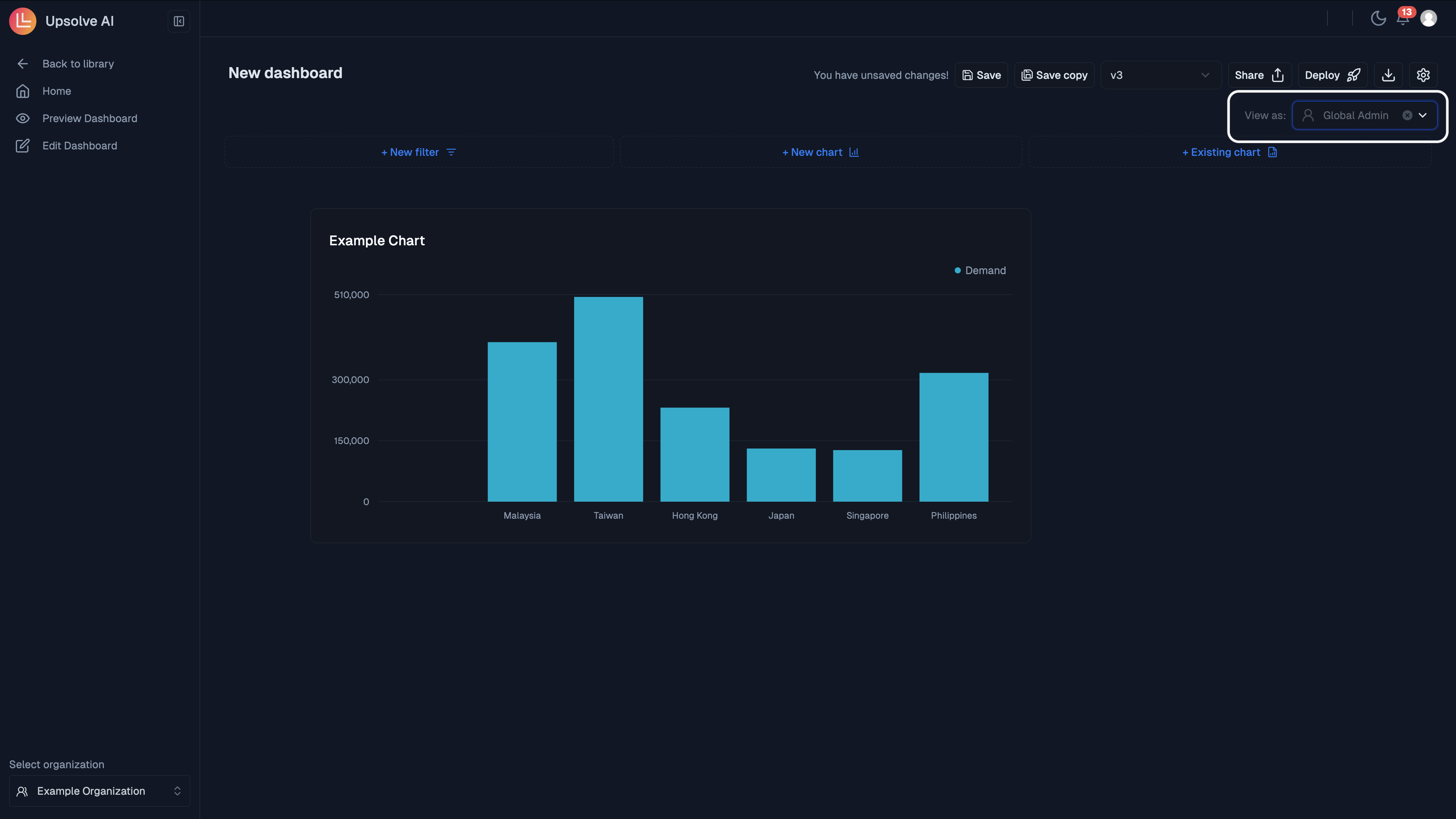
Preview Mode
Test tenant configurations by previewing dashboards as specific tenants.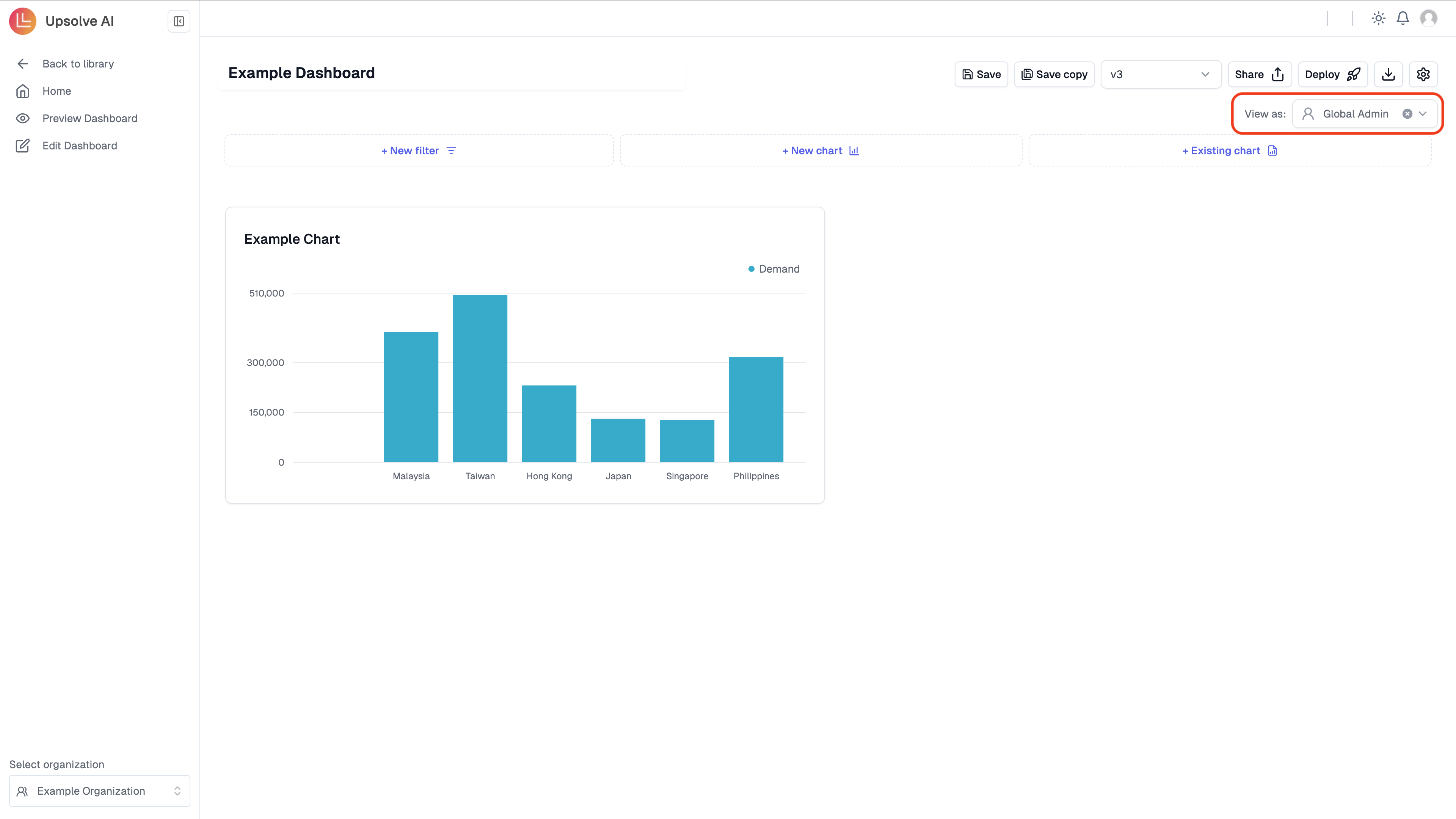
Sample Dataset Examples
Column Pre-Filtering:- Name:
Customer-1 - Column Pre-Filter:
CustomerID = User_1
- Name:
Schema-Customer - Schema:
customer_schema_1
Best Practices
- Index Column Pre-Filter columns for performance
- Grant minimal permissions required
- Validate all tenant configurations to prevent admin access
- Schema filtering generally performs better than complex Column Pre-Filtering
- Regular audits of tenant permissions and access